

Search for brain healthy foods and you will find confident lists promising sharper memory in a week. The research is more careful. Several foods are linked with better thinking or slower decline, but most of the evidence is observational, and Harvard Health Publishing stresses that no single food guarantees a sharp brain.
This guide covers eight foods with real support, what the MIND diet study did and did not show, and a simple way to build your plate. It is general information, not medical advice.
Key Takeaways
- Harvard Health lists leafy greens, fatty fish, berries, tea and coffee, and walnuts as foods linked with better brain function, but stresses that no single food guarantees a sharp brain.
- In the MIND diet study of 923 older adults, rigorous adherence was linked with up to 53 percent lower Alzheimer’s risk, though the study was observational.
- Brain healthy foods work best as a pattern: vegetables, berries, nuts, beans, whole grains, fish and olive oil.
- Choose low-mercury fish, and ask a doctor before taking omega-3 supplements.
- Brain changes that worry you are a reason to see a doctor, not to change your shopping list.
What Counts as Brain Healthy Foods?
There is no official list, so it helps to say what the term means. Brain healthy foods are foods and eating patterns that research has linked with better thinking, memory or a lower chance of cognitive decline.
“Linked” is the careful word. Most of the studies behind them watch what people eat and how their brains age, which shows an association and cannot prove cause.

That limit does not make the advice useless. The same foods are also good for the heart, blood pressure and blood sugar, which affect the brain too. If a food is nourishing for the body and has some support for the brain, it earns a place on the plate even without a guarantee.
8 Brain Healthy Foods and Why They Earn a Place
The Harvard Health article on foods linked to better brainpower names five groups, and the MIND diet adds three more. The table summarizes them with the strength of what the sources say.
| Food | Nutrient Or Compound Named | What The Source Says |
| Leafy greens | Vitamin K, Lutein, Folate, Beta Carotene | Research suggests they may help slow cognitive decline |
| Fatty Fish | Omega-3 Fatty Acids | Omega-3s are associated with lower blood levels of beta-amyloid |
| Berries | Flavonoids | A Brigham and Women’s study linked weekly servings to delayed memory decline |
| Tea And Coffee | Caffeine | Higher intake was linked with better scores on mental function tests |
| Walnuts | Alpha-Linolenic Acid | A UCLA study linked higher walnut intake to better test scores |
| Beans | Fiber, Plant Protein | Part of the MIND diet targets |
| Whole Grains | Fiber | Part of the MIND diet targets |
| Olive Oil | Unsaturated Fat | Main fat in the MIND and Mediterranean patterns |
Leafy Greens: Kale, Spinach, Collards and Broccoli
Harvard Health lists kale, spinach, collards and broccoli as sources of vitamin K, lutein, folate and beta carotene, and says research suggests these plant foods may help slow cognitive decline.

The article does not name specific studies, so read the claim as a reasonable lead, not a measured effect. The MIND diet also scores green leafy vegetables as a core food.
Fatty Fish
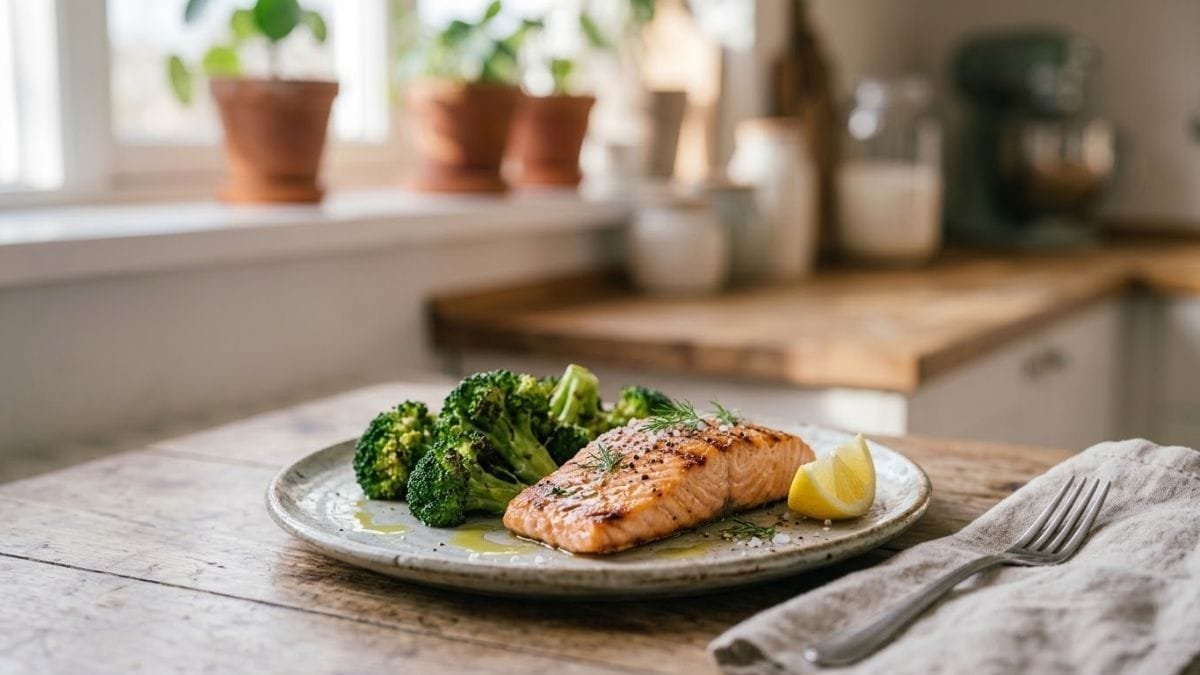
Salmon, cod, canned light tuna and pollock supply omega-3 fatty acids, which Harvard says are associated with lower blood levels of beta-amyloid, the protein that forms clumps in Alzheimer’s disease.
It advises choosing low-mercury fish and eating fish at least twice a week, with flaxseeds, avocados and walnuts as plant sources of omega-3. The Mayo Clinic’s Mediterranean diet guide similarly recommends fish or shellfish two to three times a week and adds that omega-3s may reduce inflammation.
Berries
Berries are among the best foods for brain health in the sense that they have the most specific finding.
Harvard cites a Brigham and Women’s Hospital study in which women who ate two or more servings of strawberries and blueberries weekly delayed memory decline by up to 2.5 years. The article does not describe the study design or sample size, so treat it as encouraging, not definitive.
Tea, Coffee and Walnuts
Harvard reports that a study in The Journal of Nutrition found higher caffeine intake linked with better mental function scores, and that in a Johns Hopkins study more people given a 200 mg caffeine tablet correctly identified images the next day.
For walnuts, a UCLA study linked higher consumption with better cognitive test scores, and the article ties their omega-3 content to lower blood pressure and cleaner arteries. Neither claim comes with sample sizes in the source.

What the MIND Diet Study Found
The strongest single piece of evidence on brain foods for memory as an eating pattern is the MIND diet study, published in Alzheimer’s & Dementia in February 2015 by Rush University and Harvard researchers.
According to Alzheimer’s News Today’s report, the study followed 923 participants from the Rush Memory and Aging Project, and 144 developed Alzheimer’s during an average follow-up of 4.5 years.
People who followed the diet rigorously had up to 53 percent lower risk, and those with moderate adherence about 35 percent lower risk.
The diet scores ten brain-healthy groups: green leafy vegetables, other vegetables, nuts, berries, beans, whole grains, fish, poultry, olive oil and wine. It also penalizes five unhealthy groups: red meat, butter and stick margarine, cheese, pastries and sweets, and fried or fast food.
There are firm caveats. The study was observational, so it shows an association, not proof that the diet prevents Alzheimer’s. The participants were volunteers from one city’s retirement and senior housing.
The lowest scorers also tended to have less education, more obesity and diabetes, fewer hours of physical activity and more depressive symptoms, which may confound the results. The report says further confirmatory studies are needed.

Foods Good for the Brain: A Simple Weekly Pattern
The MIND targets reported in the study give a practical template. You do not need to hit them perfectly.
- Whole grains, three servings a day. Oats, brown rice or whole wheat bread all count.
- A salad and another vegetable daily. Include leafy greens often.
- Nuts daily. A small handful of walnuts or almonds works.
- Beans every other day. Lentils, chickpeas or black beans.
- Berries and poultry at least twice a week. Fresh or frozen berries are both fine.
- Fish at least once a week. Harvard suggests twice if you can.
- Olive oil as your main cooking fat. It replaces butter, which the MIND diet limits.
How to Read Claims About Brain Foods
Watch the verbs. “Linked with,” “associated with” and “may help” describe patterns, while “boosts,” “prevents” and “cures” claim a cause that most studies cannot show. Ask also who was studied and for how long.
A finding in older volunteers from one city, or in mice, may not apply to you. Applying this filter to any list of brain healthy foods keeps your expectations realistic and your shopping basket sensible.
Foods to Boost Brain Power Right Now?
Many readers hope for a quick effect, and the only fast finding in the sources is the Johns Hopkins caffeine study, in which participants given 200 mg of caffeine remembered more of the images they studied.
That does not mean more coffee improves long-term brain health, and caffeine affects sleep and anxiety in some people. For longer-term benefits, consistency matters more than any single drink.
BitComfy has related guides on foods that help with anxiety and fruits for a healthy gut, which overlap with many of the foods above.
What Brain Healthy Foods Cannot Do
It is easy to expect too much, so say it plainly. These foods cannot reverse dementia, replace medical care or guarantee that your memory will stay sharp. Harvard stresses that no single food guarantees a sharp brain and recommends an overall healthy dietary pattern rich in fruits, vegetables, legumes, whole grains, plant and fish protein and unsaturated fats.
If you notice memory changes that worry you or the people around you, see a doctor. Diet is one useful lever among several, alongside sleep, exercise and managing blood pressure, but it is not a diagnosis tool.
FAQs
What are the best brain healthy foods?
The sources reviewed point to leafy greens, fatty fish, berries, walnuts, tea and coffee, plus beans, whole grains and olive oil as part of the MIND pattern. No single food stands above the rest.
Does the MIND diet prevent Alzheimer’s?
Not proven. The 2015 study found a lower risk with higher adherence, but it was observational, and the report says confirmatory studies are needed.
How much fish should I eat for brain health?
Harvard suggests at least twice a week, choosing low-mercury fish. The MIND targets list fish at least weekly.
Are brain supplements as good as brain healthy foods?
Harvard suggests asking a doctor about supplements if you do not eat fish. The sources reviewed do not recommend supplements over food.
Can coffee improve memory?
One Johns Hopkins study described by Harvard found better image recall the next day after a 200 mg caffeine tablet. The source gives no long-term evidence.
Conclusion
Brain healthy foods are best understood as a pattern, not a shopping list of miracle items. Leafy greens, fatty fish, berries, nuts, beans, whole grains and olive oil show up again and again in the research, and the MIND diet study linked closer adherence with lower Alzheimer’s risk, though only as an observation.
Harvard is clear that no single food guarantees a sharp brain. Choose low-mercury fish, keep portions realistic, and see a doctor about memory concerns. Your next step is to add one MIND food you rarely eat, such as beans or berries, to this week’s meals, and repeat it until it becomes a habit.